Amadeus
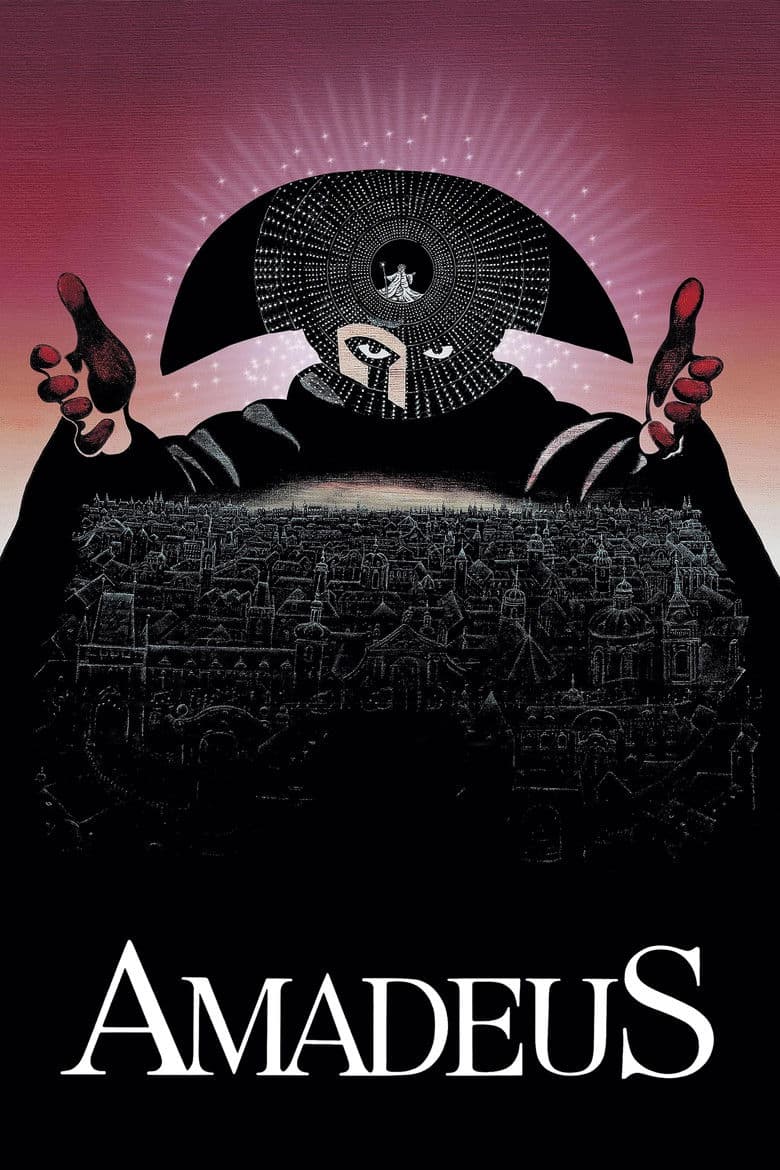
Vibe
Miloš Forman’s lavish historical drama tells the story of Wolfgang Amadeus Mozart through the bitterly fascinated perspective of court composer Antonio Salieri. Recounting his memories from confinement late in life, Salieri describes his awe at Mozart’s extraordinary musical genius and his torment at seeing such divine talent housed in a man he finds vulgar, childish, and impulsive. Tom Hulce brings Mozart a volatile mix of brilliance and immaturity, while F. Murray Abraham’s Oscar-winning performance gives Salieri the film’s tragic emotional core. Combining theatrical storytelling with richly staged performances of Mozart’s music, Amadeus remains one of cinema’s most compelling explorations of artistic genius, jealousy, and spiritual despair.
Watch for
- F. Murray Abraham’s narration and performance as Salieri, which turn admiration, bitterness, and self-pity into the film’s central dramatic engine.
- How the film stages Mozart’s compositions, especially in rehearsals and performances, to reveal character, emotion, and artistic process through music itself.
- Tom Hulce’s interpretation of Mozart, whose childish laughter and manic energy make his genius feel both miraculous and destabilizing.
- The contrast between the grandeur of imperial Vienna and Salieri’s increasingly private torment, which gives the film its tension between public spectacle and inner collapse.
Production notes
Amadeus was Miloš Forman's adaptation of Peter Shaffer's 1979 stage play, which Shaffer himself adapted for the film. The play and film fictionalize the relationship between composer Wolfgang Amadeus Mozart and his Viennese contemporary Antonio Salieri — taking substantial liberties with historical fact to construct a meditation on mediocre talent's relationship with genius. F. Murray Abraham played Salieri (older man and as the young court composer), with Tom Hulce as Mozart in a performance that emphasized the composer's documented eccentric and almost-childlike personality. Elizabeth Berridge played Mozart's wife Constanze, with Roy Dotrice as Mozart's father Leopold, Christine Ebersole as the soprano Caterina Cavalieri, and Jeffrey Jones as Emperor Joseph II. Cinematographer Miroslav Ondříček shot the film primarily in Prague, where Forman could film in actual 18th-century theatrical spaces. The Mozart music was largely performed by Sir Neville Marriner and the Academy of St Martin in the Fields. Production cost approximately $18 million.
Trivia
- Both F. Murray Abraham (Salieri) and Tom Hulce (Mozart) were nominated for the Best Actor Academy Award — making them the only paired co-leads from the same film to receive separate Best Actor nominations in Oscar history; Abraham won, with Hulce losing to Abraham in one of the more interesting Best Actor outcomes of the 1980s.
- The film was shot primarily in Prague — then in Czechoslovakia behind the Iron Curtain — and Miloš Forman (a Czech expatriate who had left Czechoslovakia in 1968) returned to direct his first film in his homeland in over fifteen years; the production benefited from Prague's preserved 18th-century theaters and architecture.
- Peter Shaffer's 1979 stage play and Amadeus screenplay take substantial liberties with historical fact — actual Mozart-Salieri relations are not believed to have been hostile, and the poison-via-Requiem-commission plot is entirely fictional; Shaffer himself acknowledged that the film is best understood as a meditation on talent rather than as biography.
- The Mozart music was largely performed by Sir Neville Marriner and the Academy of St Martin in the Fields; Marriner reportedly took the project specifically to ensure musical authenticity, and the resulting soundtrack album sold over five million copies, introducing classical music to mainstream audiences.
- Amadeus won eight Academy Awards including Best Picture, Best Director (Forman), Best Actor (Abraham), Best Adapted Screenplay (Shaffer), Best Art Direction, Best Costume Design, Best Makeup, and Best Sound — making it one of the most thoroughly Oscar-celebrated films of the 1980s.
Legacy
Amadeus won eight Academy Awards on eleven nominations, and was selected for the National Film Registry in 2019. The film grossed approximately $52 million domestically — extraordinary for a three-hour period drama with no major stars — and the soundtrack album sold over five million copies. Tom Hulce's portrayal of Mozart's high-pitched, childlike laugh has become one of the most-quoted character details in American cinema, embedded in popular culture for decades. The film's central thematic concern — the suffering of recognizing talent in another that one cannot match in oneself — has aged into one of the most-cited American treatments of artistic envy and mediocrity, with F. Murray Abraham's Salieri becoming the canonical literary figure for that specific psychological condition. The 2002 Director's Cut, restoring approximately 20 minutes of footage, became the preferred version for many critics and is the version generally screened in repertory contexts. Among 1980s American prestige dramas, Amadeus stands as one of the most thoroughly satisfying syntheses of intellectual ambition with mainstream commercial appeal.