Bonnie and Clyde
Vibe
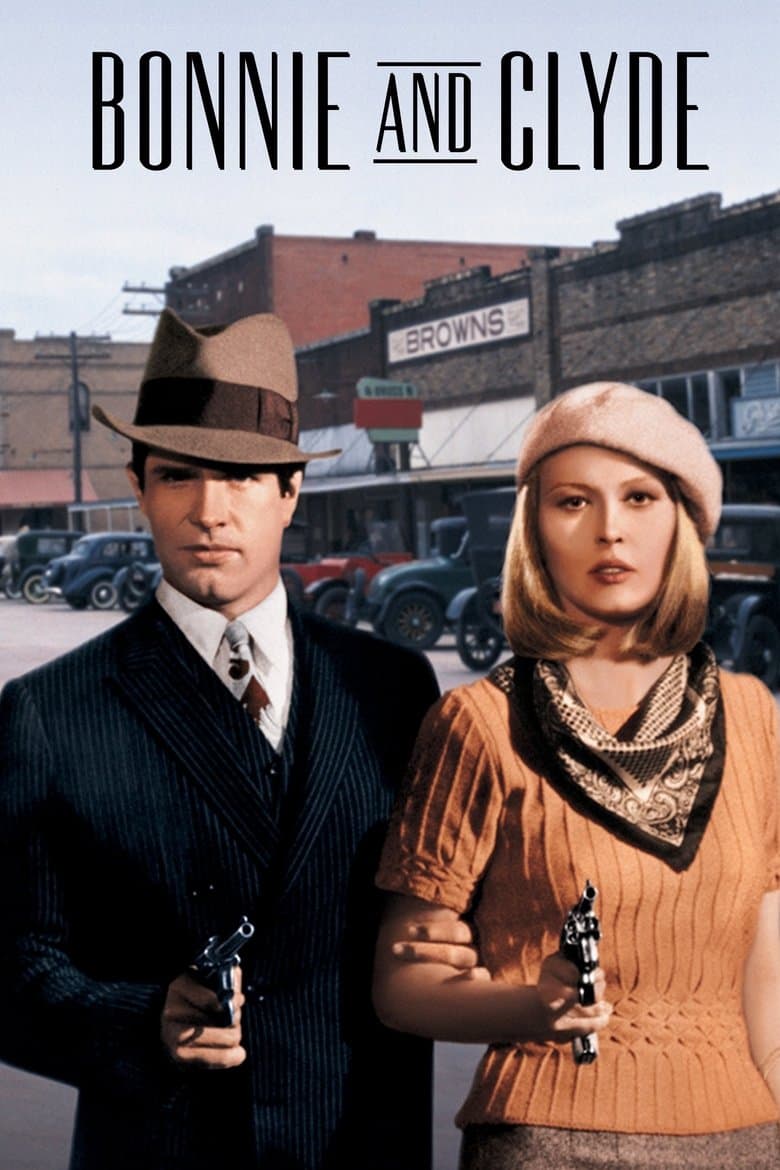
Arthur Penn’s influential crime drama recounts the rise and fall of Depression-era outlaws Bonnie Parker and Clyde Barrow. Bored with small-town life and drawn to the thrill of rebellion, the pair embark on a string of bank robberies across the American South, quickly becoming both media sensations and targets of an expanding manhunt. Warren Beatty and Faye Dunaway bring charisma and tragic intensity to the infamous couple, portraying them as both romantic dreamers and reckless fugitives. Blending moments of humor, tenderness, and shocking violence, the film challenged traditional Hollywood storytelling and censorship norms. Often credited with helping launch the New Hollywood movement, Bonnie and Clyde remains a landmark in the transformation of modern American cinema.
Watch for
- The electric chemistry between Warren Beatty and Faye Dunaway, which drives the film’s mixture of romance and recklessness.
- Arthur Penn’s stylized violence, especially in the film’s famous final ambush sequence.
- Rapid editing and tonal shifts between comedy, intimacy, and brutality.
- How the film portrays Bonnie and Clyde as both folk heroes and tragic figures doomed by their own choices.
Production notes
Bonnie and Clyde was Arthur Penn's adaptation of David Newman and Robert Benton's screenplay, which had been developed for years and had been rejected by François Truffaut and Jean-Luc Godard before Warren Beatty acquired it. Beatty championed the project to Warner Bros., produced it himself, and starred as Clyde Barrow opposite Faye Dunaway as Bonnie Parker. The supporting cast included Gene Hackman as Buck Barrow, Estelle Parsons as Blanche, Michael J. Pollard as C.W. Moss, and Gene Wilder in his film debut. The film's stylized violence — particularly the slow-motion final ambush — was explicitly modeled on French New Wave cinema (Jean-Luc Godard's Breathless and Pierrot le Fou) and represented a major break from American cinema's earlier conventions for depicting violence. Cinematographer Burnett Guffey shot the film. Composer Charles Strouse contributed the score, with the famous Flatt and Scruggs banjo song 'Foggy Mountain Breakdown' providing the film's most recognizable music. Production cost approximately $2.5 million.
Trivia
- François Truffaut and Jean-Luc Godard both rejected the screenplay before Warren Beatty's involvement; the rejection is reported to have been an aesthetic choice — both directors felt the gangster genre was American territory better suited to American filmmakers — rather than a quality judgment on the script.
- Gene Wilder's film debut role as Eugene Grizzard, the kidnapped undertaker, was small but distinctive; Wilder had been working in theater and had not previously appeared in films, and Bonnie and Clyde launched the career that would include The Producers, Willy Wonka, and Blazing Saddles.
- The famous slow-motion final ambush sequence — over 20 seconds of bullet-riddled bodies in elaborate slow motion — was groundbreaking for American cinema's depiction of violence; the sequence was directly inspired by Akira Kurosawa's Seven Samurai (1954) and went on to influence subsequent violent films from The Wild Bunch to Quentin Tarantino's work.
- Estelle Parsons won the Academy Award for Best Supporting Actress as Blanche Barrow, beating Sondra Locke and Mildred Natwick among others; the win was widely seen as recognition of one of the more emotionally raw supporting performances in 1960s American cinema.
- Bonnie and Clyde grossed approximately $50 million on its $2.5 million budget — an enormous return that helped establish the New Hollywood era's commercial template; the film's success demonstrated that adult-themed dramatic features could compete with the family-oriented and big-budget productions that had dominated the early 1960s.
Legacy
Bonnie and Clyde is widely regarded as the inaugural film of the New Hollywood era — the moment when American cinema began responding to French New Wave aesthetics, social-political turmoil, and youth-counterculture consciousness. It received ten Academy Award nominations and won two — Best Supporting Actress (Estelle Parsons) and Best Cinematography (Burnett Guffey). It was selected for the National Film Registry in 1992. Faye Dunaway's central performance as Bonnie has been continuously celebrated, and her costuming (1930s-era beret-and-skirt with cardigan layering) shaped fashion across the late 1960s. Pauline Kael's New Yorker review championed the film and helped legitimize the more visceral, morally complex American cinema that would dominate the next decade — Pauline Kael's defense of the film against the largely negative initial critical reception became one of the seminal acts of 1960s American film criticism. Among films of the New Hollywood era, Bonnie and Clyde remains the canonical text of the moment when American genre cinema began treating its own conventions with serious self-awareness.