A Clockwork Orange
Vibe
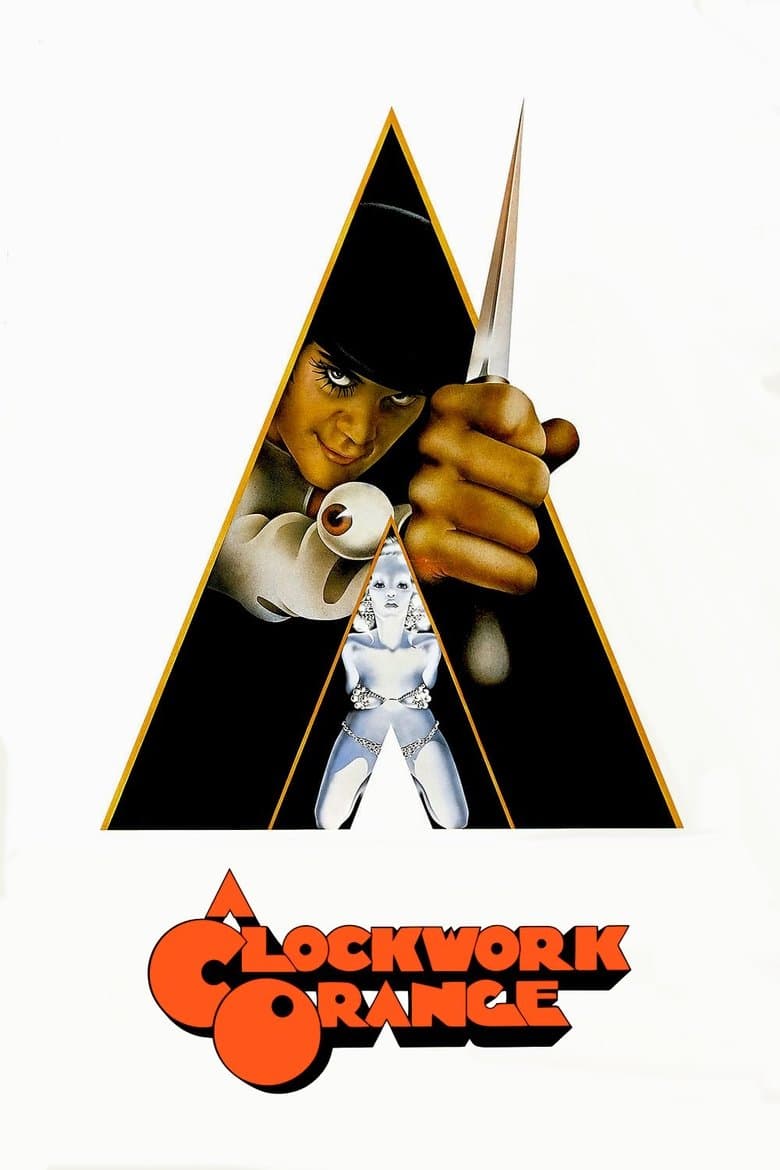
Stanley Kubrick’s provocative dystopian drama follows Alex DeLarge, a charismatic and terrifying young delinquent who leads a gang through a spree of stylized violence in a near-future Britain. After his arrest, Alex becomes the subject of an experimental state program designed to condition him against criminal behavior, turning punishment into a disturbing test of free will itself. Kubrick stages the film with icy precision, using bold production design, wide-angle compositions, and ironic bursts of classical music to heighten its unsettling effect. Malcolm McDowell’s performance gives Alex both magnetic charm and chilling unpredictability. Controversial from the moment of its release, A Clockwork Orange remains one of cinema’s boldest explorations of violence, morality, and social control.
Watch for
- Malcolm McDowell’s performance, which makes Alex at once charismatic, childish, theatrical, and deeply unsettling.
- Kubrick’s use of classical music, especially the way elegance and brutality collide to create irony, distance, and dread.
- The film’s carefully designed interiors, costumes, and slang, which create a fully realized world that feels both futuristic and perversely familiar.
- How the Ludovico treatment scenes shift the film from delinquent nightmare to moral argument about state power, coercion, and the limits of rehabilitation.
Production notes
A Clockwork Orange was Stanley Kubrick's adaptation of Anthony Burgess's 1962 novel, with the screenplay by Kubrick himself. The film was shot in England and was distinguished by its extraordinary visual design — Burgess's invented Nadsat slang, the deliberately retro-futuristic production design (early-1970s Britain styled as a near-future), the elaborate costume work, and the iconic eyeball-prosthetic close-up of Alex DeLarge during the Ludovico Technique sequences. Malcolm McDowell played Alex in a performance that has remained one of the most disturbing in British cinema. The supporting cast included Patrick Magee as the writer Mr. Alexander, Michael Bates as the prison Chief Guard, Adrienne Corri as Mrs. Alexander, and Aubrey Morris as Deltoid. Cinematographer John Alcott shot the film, beginning his Kubrick collaboration that would extend to Barry Lyndon (1975) and The Shining (1980). The film featured an extensive use of classical music, particularly Beethoven's Ninth Symphony, the William Tell Overture, and Henry Purcell's Music for the Funeral of Queen Mary. Production cost approximately $2.2 million.
Trivia
- Stanley Kubrick voluntarily withdrew A Clockwork Orange from theatrical release in the United Kingdom in 1973 after copycat acts of violence by youth gangs were attributed to the film; the British ban remained in place until Kubrick's 1999 death, when his estate finally allowed UK theatrical re-release.
- Malcolm McDowell's Alex was forced to keep his eyes open during the Ludovico Technique sequences via metal lid-locks — an actual procedure that genuinely scratched McDowell's cornea during filming, requiring medical treatment and several days of production delay.
- Anthony Burgess later expressed substantial dissatisfaction with both the novel and Kubrick's adaptation, particularly the American edition's removal of his original final chapter that depicts Alex's eventual moral redemption; Burgess reportedly resented his association with the violence-focused work for the rest of his life.
- The film features Wendy Carlos's electronic score — Carlos (formerly Walter Carlos) was one of the pioneers of the Moog synthesizer, and her 1968 album Switched-On Bach had brought classical music into electronic territory; her A Clockwork Orange synthesizer adaptations of Beethoven became one of the most distinctive scoring approaches of the early 1970s.
- A Clockwork Orange received four Academy Award nominations including Best Picture, Best Director (Kubrick), Best Adapted Screenplay (Kubrick), and Best Film Editing; it lost Best Picture and Best Director to The French Connection in one of the more contested years of early-1970s Oscar voting.
Legacy
A Clockwork Orange is widely regarded as one of Stanley Kubrick's most morally controversial and thoroughly disquieting films. It received four Academy Award nominations (winning none) and was selected for the National Film Registry in 2020. The film's central thematic concern — the moral cost of behavioral conditioning, the relationship between free will and societal coercion — has remained continuously relevant across decades of subsequent American debate about criminal-justice reform, behavioral therapy, and the limits of state power. Stanley Kubrick's voluntary 1973 UK withdrawal of the film became one of the most-discussed acts of director-imposed self-censorship in cinema history, and the 26-year UK absence created an extended period during which the film circulated only through bootleg copies and tourist-purchased versions — generating substantial underground cult around its eventual 1999 official release. Malcolm McDowell's Alex DeLarge has become one of the canonical disturbed protagonists of American cinema, and the film's visual design (droogs in white coveralls, bowler hats, false eyelashes, codpieces) has been continuously referenced in subsequent decades of fashion, music, and visual art.