Close Encounters of the Third Kind
Vibe
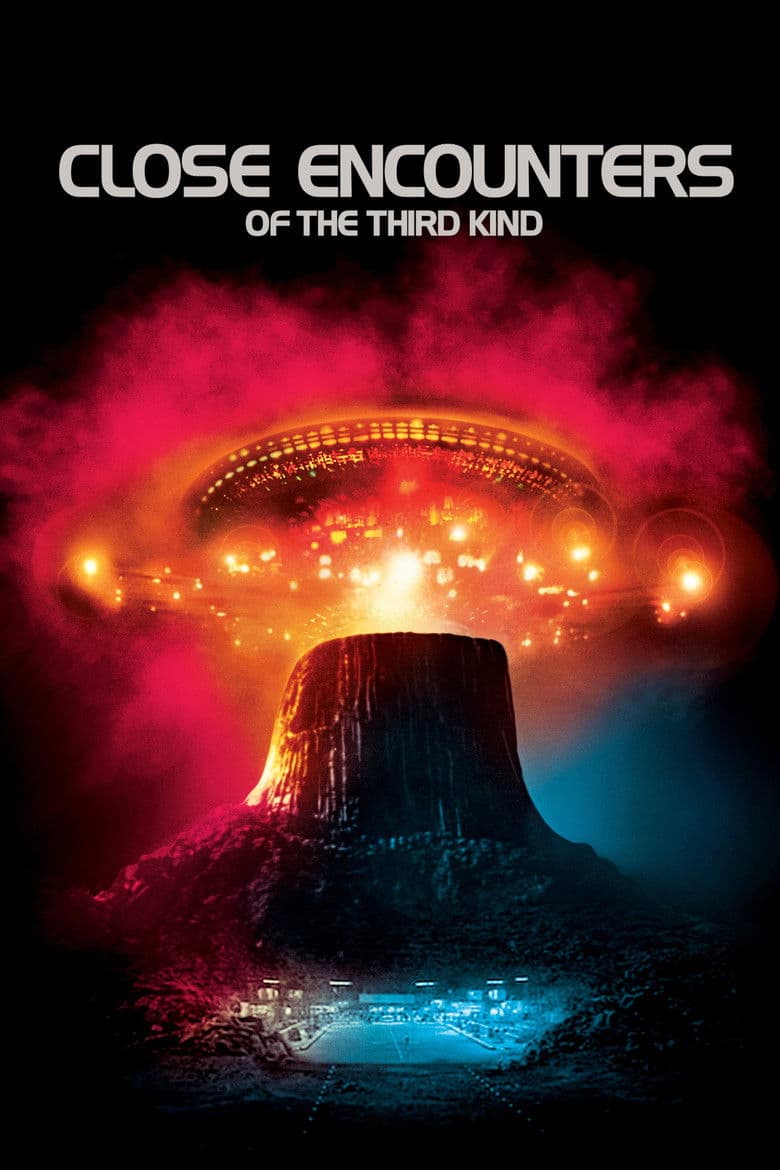
Steven Spielberg’s science fiction drama approaches extraterrestrial contact not through war or invasion, but through awe, obsession, and the pull of the unknown. After an encounter with a UFO, Indiana utility worker Roy Neary becomes consumed by visions of a mysterious mountain shape he cannot explain, even as scientists across the globe begin tracing patterns that suggest an extraordinary event is approaching. Richard Dreyfuss gives Roy’s fixation an unsettling urgency, while Spielberg balances domestic disruption, cosmic mystery, and childlike wonder with unusual grace. Featuring groundbreaking visual effects and an unforgettable musical language of communication, Close Encounters of the Third Kind helped redefine science fiction as a cinema of curiosity, transcendence, and possibility.
Watch for
- How Spielberg stages ordinary spaces—suburbs, highways, living rooms, power stations—as places where the extraordinary gradually intrudes.
- Richard Dreyfuss’s performance, especially the way Roy’s wonder, anxiety, and obsession slowly overtake every part of his life.
- The film’s use of light and sound as forms of communication, culminating in the famous tonal exchange between humans and the visitors.
- The tonal balance between domestic realism and cosmic spectacle, which allows the climactic encounter to feel both intimate and overwhelming.
Production notes
Close Encounters of the Third Kind was Steven Spielberg's follow-up to his Jaws breakthrough — and the project he had been developing since age 8, when he had started making 8mm science-fiction shorts. Spielberg wrote the original screenplay himself (Paul Schrader contributed an earlier draft that Spielberg substantially rewrote, with Schrader receiving no on-screen credit despite Writers Guild arbitration). Richard Dreyfuss played Roy Neary, the suburban electrical engineer-father whose UFO encounter destroys his family life. The cast included François Truffaut (in his only American film acting role) as the French scientist Claude Lacombe, Teri Garr as Roy's wife Ronnie, Melinda Dillon as Jillian Guiler (whose young son is abducted), Bob Balaban as the interpreter David Laughlin, and Cary Guffey as the abducted child Barry. The famous Devil's Tower-climax sequence was filmed at the actual Wyoming national monument. Cinematographer Vilmos Zsigmond shot the film. Composer John Williams contributed the iconic five-note alien-communication theme. Production cost approximately $20 million.
Trivia
- François Truffaut — the French New Wave director (The 400 Blows, Jules and Jim, Day for Night) — made his only American film acting appearance as the French scientist Claude Lacombe; the casting was unusual because Truffaut was uncomfortable in English and had to be coached substantially through the production.
- The famous five-note alien-communication theme was composed by John Williams in collaboration with Spielberg; Spielberg had specifically requested 'something short, memorable, that an entire orchestra could play' and Williams's resulting motif became one of the most-recognized pieces of film music ever composed.
- The Devil's Tower-climax sequence was filmed at the actual Wyoming national monument — Devils Tower National Monument, the United States' first declared national monument from 1906; the location was chosen because of the volcanic-rock pillar's distinctive visual qualities and its association with Native American spiritual traditions.
- The film's famous bench-shot — Roy Neary, traumatized and isolated, working on his mashed-potato Devil's Tower replica while his family watches — was reportedly suggested to Spielberg by François Truffaut during production; the sequence has become one of the most-quoted moments in the film.
- Close Encounters received eight Academy Award nominations and won one — Best Cinematography for Vilmos Zsigmond; it received a special achievement Oscar for Sound Effects Editing (which would be reformulated as a competitive category the following year).
Legacy
Close Encounters of the Third Kind was a substantial commercial success, grossing approximately $338 million worldwide on its $20 million budget. It received eight Academy Award nominations and won one (Best Cinematography for Vilmos Zsigmond). It was selected for the National Film Registry in 2007. The film established the alien-encounter narrative template that would shape subsequent decades of science-fiction cinema — emphasizing wonder, awe, and benign extraterrestrial intelligence rather than the threat-based aliens of 1950s pulp tradition. The five-note alien-communication theme has become one of the most-recognized pieces of film music ever composed, embedded in popular culture across multiple decades. The film's specific approach — domestic-American characters drawn into vast cosmic mystery, the spiritual-religious overtones of the climactic encounter, the visual spectacle of the mothership — has been continuously referenced and imitated across subsequent science-fiction work. Among Spielberg's films, Close Encounters sits alongside E.T. (1982) as the canonical text of his benign-extraterrestrial-wonder mode, distinct from his later more morally complex science-fiction work in War of the Worlds and A.I.