Guess Who's Coming to Dinner
Vibe
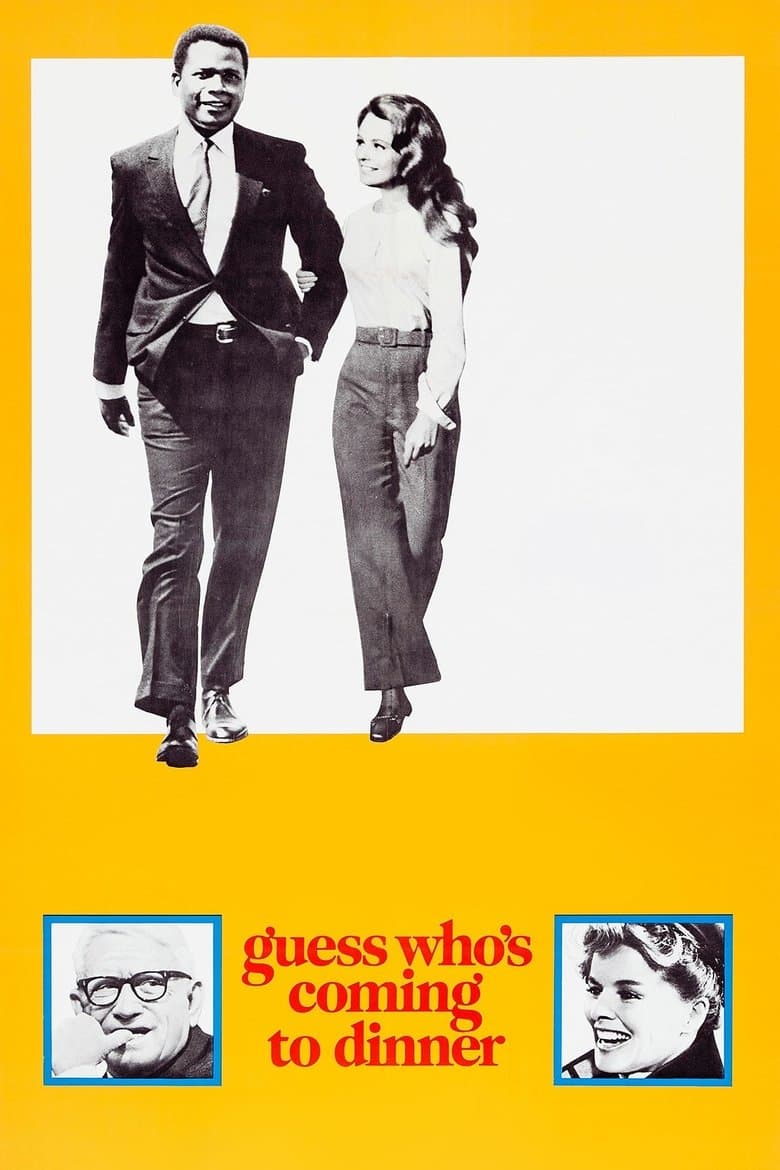
Stanley Kramer’s socially conscious drama begins when a young white woman brings her fiancé home to meet her progressive parents, only to reveal that he is Black and that the couple intends to marry soon. What follows is not a courtroom battle or public controversy, but an intimate domestic reckoning in which each family member must confront the distance between professed liberal values and personal prejudice. Spencer Tracy and Katharine Hepburn bring gravity and tenderness to the parents’ struggle, while Sidney Poitier’s poised performance gives the fiancé warmth, intelligence, and dignity. Released at a pivotal moment in American civil rights history, Guess Who’s Coming to Dinner remains a landmark film about race, love, and moral self-examination.
Watch for
- How the film uses the confined setting of one family home to turn dinner-table conversation and private exchanges into a pressure chamber of moral and emotional tension.
- Spencer Tracy’s performance in the final act, where hesitation, fatigue, love, and hard-won clarity give the film its emotional center.
- Sidney Poitier’s carefully controlled presence, which reflects both the film’s ideals and the burden placed on his character to appear beyond reproach in order to be accepted.
- The contrast between the parents’ self-image as tolerant people and the discomfort that surfaces once principle becomes personal, revealing the film’s central dramatic conflict.
Production notes
Guess Who's Coming to Dinner was Stanley Kramer's drama about a wealthy white liberal San Francisco couple whose daughter brings home her Black fiancé for the first family meeting. The screenplay by William Rose was deliberately constructed as a contemporary social-message film during the height of American civil rights debates — the film was released in December 1967, six months after Loving v. Virginia (the Supreme Court's June 1967 ruling that struck down interracial marriage bans). The cast was anchored by three Hollywood legends: Spencer Tracy (in his ninth and final pairing with Katharine Hepburn) as the patriarch Matt Drayton, Hepburn as his wife Christina, and Sidney Poitier as the brilliant young Black physician John Prentice. The cast also included Katharine Houghton (Hepburn's actual niece) as the daughter Joanna Drayton, Cecil Kellaway as Monsignor Ryan, Beah Richards and Roy Glenn as John's parents, and Isabel Sanford as the family housekeeper Tillie Banks. Cinematographer Sam Leavitt shot the film. Composer Frank De Vol contributed the score. Spencer Tracy died of a heart attack on June 10, 1967 — only seventeen days after the film completed shooting and six months before its theatrical release. Production cost approximately $4 million.
Trivia
- Spencer Tracy died of a heart attack on June 10, 1967 — only seventeen days after the film completed shooting and six months before its theatrical release; Tracy and Katharine Hepburn had been romantically involved for over twenty years (though Tracy never divorced his wife Louise), and the film was their ninth and final pairing — making Tracy's posthumous Best Actor nomination one of the more emotionally substantial Oscar nominations of the late 1960s.
- Katharine Houghton, who played the daughter Joanna Drayton, was Katharine Hepburn's actual niece — the daughter of Hepburn's sister Marion; the casting was Hepburn's substantial personal choice, with Houghton drawn into a substantial Hollywood role through family connection.
- The film was released in December 1967, six months after Loving v. Virginia (the Supreme Court's June 1967 ruling that struck down state interracial marriage bans); the production had been planned and shot in the substantial uncertainty around the Loving case, with the film's release timing capitalizing on the contemporary social-political moment.
- Sidney Poitier was simultaneously appearing in three substantial 1967 films — Guess Who's Coming to Dinner, In the Heat of the Night, and To Sir, with Love — all of which received substantial commercial success; the three films collectively established Poitier as the dominant Black leading man in mainstream American cinema, a position no Black actor would substantially match for nearly two decades.
- Guess Who's Coming to Dinner won two Academy Awards — Best Actress (Katharine Hepburn) and Best Original Screenplay (William Rose); the film received ten total nominations including Best Picture (losing to In the Heat of the Night, another Sidney Poitier-led civil-rights-themed drama).
Legacy
Guess Who's Coming to Dinner received ten Academy Award nominations and won two — Best Actress (Katharine Hepburn) and Best Original Screenplay (William Rose). It was selected for the National Film Registry in 2017. The film's specific commercial-and-critical achievement — a major-studio mainstream production that explicitly engaged with the contemporary interracial-marriage debate, released during the immediate aftermath of Loving v. Virginia (1967) — has been continuously cited as one of the canonical examples of Hollywood's substantial late-1960s engagement with the American civil rights movement. The film's contemporary 1960s reception was substantial, but subsequent critical reassessment has been more mixed — some critics have argued the film's white-liberal-perspective framing is substantially limited, with the Black characters (despite Sidney Poitier's substantial screen presence) functioning primarily to validate the white protagonists' moral development rather than as fully developed characters in their own right. Spencer Tracy's posthumous Best Actor nomination — given his death only seventeen days after the film's shooting wrapped and his approximately twenty-year romantic involvement with Katharine Hepburn — has remained one of the most emotionally substantial Oscar contexts in late-1960s American cinema.