King Kong
Vibe
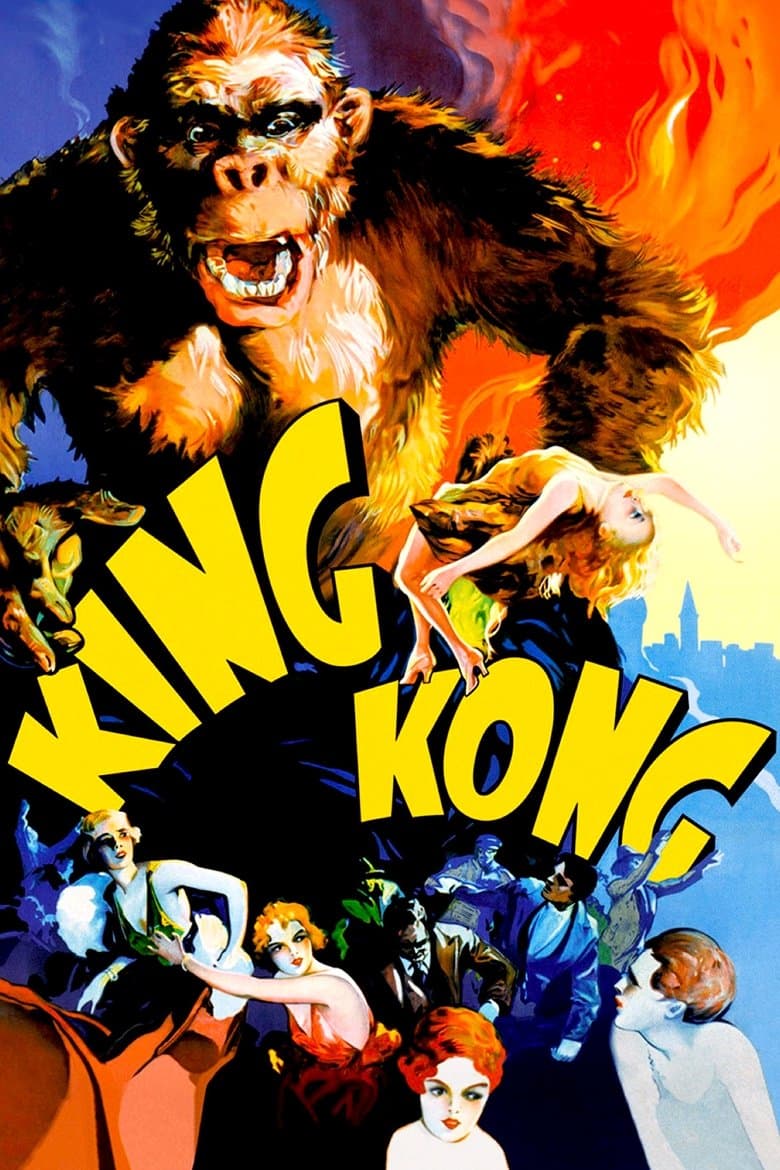
This groundbreaking adventure fantasy follows filmmaker Carl Denham and his crew as they journey to the mysterious Skull Island, where they encounter a colossal ape revered by the island’s inhabitants. After Kong is captured and transported to New York as a sensational attraction, the spectacle quickly collapses into terror when he breaks free and rampages through the city. Willis O’Brien’s pioneering stop-motion animation gave Kong a startling sense of scale, movement, and personality, helping redefine what cinema could visualize. Beneath its thrills, the film carries a surprising melancholy, turning the monster into a tragic figure caught between wonder, exploitation, and destruction. King Kong remains one of the great landmarks of early fantasy and special-effects filmmaking.
Watch for
- Willis O’Brien’s stop-motion work, especially the way Kong’s movement and expressions give the creature weight, menace, and unexpected feeling.
- How the film shifts in tone from expedition adventure to jungle nightmare to urban catastrophe without losing narrative momentum.
- The contrast between Skull Island’s primal atmosphere and the modern spectacle culture of New York, which sharpens the film’s themes of capture and exploitation.
- The Empire State Building climax, where special effects, scale, and emotion converge into one of the most iconic final images in cinema history.
Production notes
King Kong was Merian C. Cooper and Ernest B. Schoedsack's adventure-fantasy production for RKO Radio Pictures, with stop-motion animation by Willis O'Brien — whose earlier work on The Lost World (1925) had established the dinosaur-stop-motion vocabulary that Kong would refine. The film combined extensive miniature work, rear-projection techniques, and stop-motion creature animation in ways unprecedented for its era. The screenplay was by James Ashmore Creelman and Ruth Rose (Schoedsack's wife). Fay Wray played Ann Darrow, with Robert Armstrong as Carl Denham, the filmmaker who captures Kong, and Bruce Cabot as Jack Driscoll. Most of Kong's screen time was achieved through approximately 18-inch armatured stop-motion models; the famous Empire State Building climax used a combination of full-size mechanical Kong arm and stop-motion model work, with Wray performing in close-up against the practical effects. Cinematographer Edward Linden shot the film. Composer Max Steiner contributed the score — one of the first major orchestral scores in American sound cinema. Production cost approximately $670,000.
Trivia
- King Kong's stop-motion animation was performed primarily on approximately 18-inch armatured models by Willis O'Brien and his team; the painstaking frame-by-frame technique required approximately 24 model adjustments per second of finished screen time, and the entire animation work took over a year.
- Fay Wray was 25 when she made the film and reportedly had been told she would be cast opposite 'the tallest, darkest leading man in Hollywood' before learning the role was opposite the giant ape; Wray became the canonical 'scream queen' of the era and her famous high-pitched scream was reused in subsequent horror films for decades.
- The film's iconic Empire State Building climax was filmed less than two years after the building's actual 1931 completion; the choice to set the climax on America's then-newest tallest building reflected the production team's commitment to contemporary urban iconography.
- Composer Max Steiner's symphonic score for King Kong is regularly cited as one of the foundational works of American film music; it was one of the first major orchestral scores in American sound cinema and established the leitmotivic-orchestral approach that would dominate Hollywood scoring for the next several decades.
- King Kong was an enormous commercial success on its 1933 release, grossing approximately $2 million domestically against its $670,000 budget — a return that reportedly saved RKO Radio Pictures from bankruptcy and helped establish the studio as a major player through the next decade.
Legacy
King Kong is one of the most enduringly influential American films of the 1930s and the foundational text of the giant-monster-creature genre. It was selected for the National Film Registry in 1991. The film's commercial success on its 1933 release reportedly saved RKO Radio Pictures from bankruptcy and helped establish American genre cinema's commercial viability during the depths of the Great Depression. The film has generated multiple direct remakes (1976 with Jeff Bridges and Jessica Lange, 2005 with Naomi Watts and Adrien Brody and directed by Peter Jackson, and the 2017 Kong: Skull Island), countless sequels and crossover films (Son of Kong, King Kong vs. Godzilla, Kong: Skull Island, Godzilla vs. Kong), and an enormous footprint in subsequent American popular culture. The Empire State Building climax has become permanent visual shorthand for impossible scale, parodied across decades of comedy and adventure films. Willis O'Brien's stop-motion animation work on the film established techniques that would directly inspire Ray Harryhausen (O'Brien's protégé) and the entire stop-motion creature tradition extending through Star Wars and the late-1990s digital-effects revolution.