The Sound of Music
Vibe
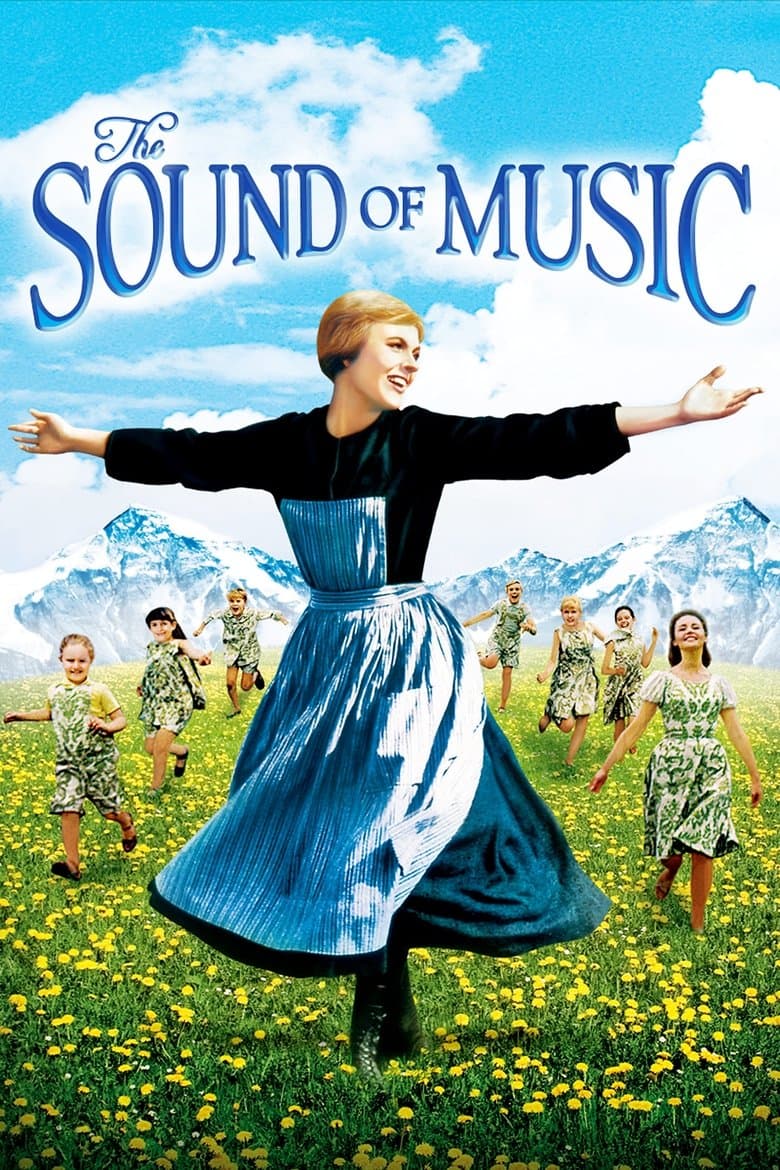
This beloved musical follows Maria, a spirited young postulant who is sent from an Austrian abbey to serve as governess for the seven children of widowed naval officer Captain Georg von Trapp. With warmth, music, and irrepressible energy, she gradually brings joy and spontaneity back into a household ruled by strict discipline. As Maria grows closer to the family, the story expands beyond romance and domestic transformation to confront the looming threat of Nazi annexation. Julie Andrews’s luminous performance and Rodgers and Hammerstein’s unforgettable songs helped make the film an international phenomenon. Blending family drama, romance, and historical upheaval, The Sound of Music remains one of the most enduring movie musicals ever made.
Watch for
- Julie Andrews’s performance, especially the way she balances Maria’s playfulness, sincerity, and growing emotional maturity.
- How the songs shape character and relationships, from the children’s early stiffness to the family’s gradual sense of unity and freedom.
- Robert Wise’s use of Austrian landscapes and expansive compositions, which give the film both storybook beauty and a sense of national identity under threat.
- The tonal shift in the final stretch, where the film moves from musical delight to suspense and political danger without losing its emotional core.
Production notes
The Sound of Music was Robert Wise's adaptation of the 1959 Rodgers and Hammerstein Broadway musical (based on Maria von Trapp's 1949 memoir The Story of the Trapp Family Singers). The screenplay by Ernest Lehman streamlined the stage version while adding location-shot Austrian sequences that would become some of the most famous in any American musical. Julie Andrews played Maria — the casting decision that essentially defined her screen career, even though her Mary Poppins (1964) had been released earlier — with Christopher Plummer as Captain Georg von Trapp, Eleanor Parker as the Baroness Schraeder, Richard Haydn as Max Detweiler, Peggy Wood as the Mother Abbess, and a septet of child performers including Charmian Carr as Liesl. The famous opening — Andrews twirling with arms wide on an Austrian mountainside, singing 'The Hills Are Alive' — was shot on location in the Salzkammergut region. Cinematographer Ted McCord shot the film in Todd-AO 70mm. Production cost approximately $8.2 million.
Trivia
- Christopher Plummer famously disliked the film throughout his career, joking that it should have been called 'The Sound of Mucus' and reportedly being uncomfortable with the saccharine register of his role; he later reconciled with the work in his later years, acknowledging its sustained importance to audiences.
- The famous opening shot — Julie Andrews twirling with arms wide on an Austrian mountainside, singing 'The Hills Are Alive' — required cinematographer Ted McCord and a helicopter mount, with the propeller wash knocking Andrews down repeatedly during multiple takes; the shot became one of the most iconic openings in any American musical.
- The Sound of Music was the highest-grossing film of all time on its 1965 release, surpassing Gone with the Wind in domestic box office; the film held the highest-grossing-film title until The Godfather surpassed it in 1972, and adjusted for inflation, it remains one of the most thoroughly successful American films ever released.
- The actual von Trapp family did not approve of the screen depiction of their patriarch Georg von Trapp; Maria von Trapp herself was reportedly satisfied with Julie Andrews's performance, but the family considered Christopher Plummer's stern depiction of Captain von Trapp to be substantially inaccurate to her late husband's actually warm personality.
- The Sound of Music won five Academy Awards including Best Picture, Best Director (Wise), Best Sound, Best Film Editing, and Best Adaptation Score; it lost Best Actress (Julie Andrews) to Julie Christie for Darling, in what was widely considered one of the more surprising losses of the mid-1960s.
Legacy
The Sound of Music was the highest-grossing film of all time on its 1965 release, surpassing Gone with the Wind in domestic box office; the film held the highest-grossing-film title until The Godfather surpassed it in 1972. It won five Academy Awards including Best Picture and Best Director, and was selected for the National Film Registry in 2001. The film's central image — Julie Andrews twirling with arms wide on an Austrian mountainside — has become permanent visual shorthand for joyous freedom, regularly referenced and parodied across decades of subsequent media. Salzburg's tourism economy was substantially shaped by the film, with 'Sound of Music tours' continuing to operate over fifty years after its release. The Rodgers and Hammerstein songs — 'My Favorite Things,' 'Edelweiss,' 'Do-Re-Mi,' 'Climb Ev'ry Mountain' — have become some of the most performed pieces in American popular-music repertoire. The 2013 NBC live-television production starring Carrie Underwood as Maria reintroduced the work to a new generation, and the film's continuing American family-viewing tradition has remained extraordinarily durable. Among American musicals, The Sound of Music stands as the most thoroughly commercially successful.