On the Waterfront
Vibe
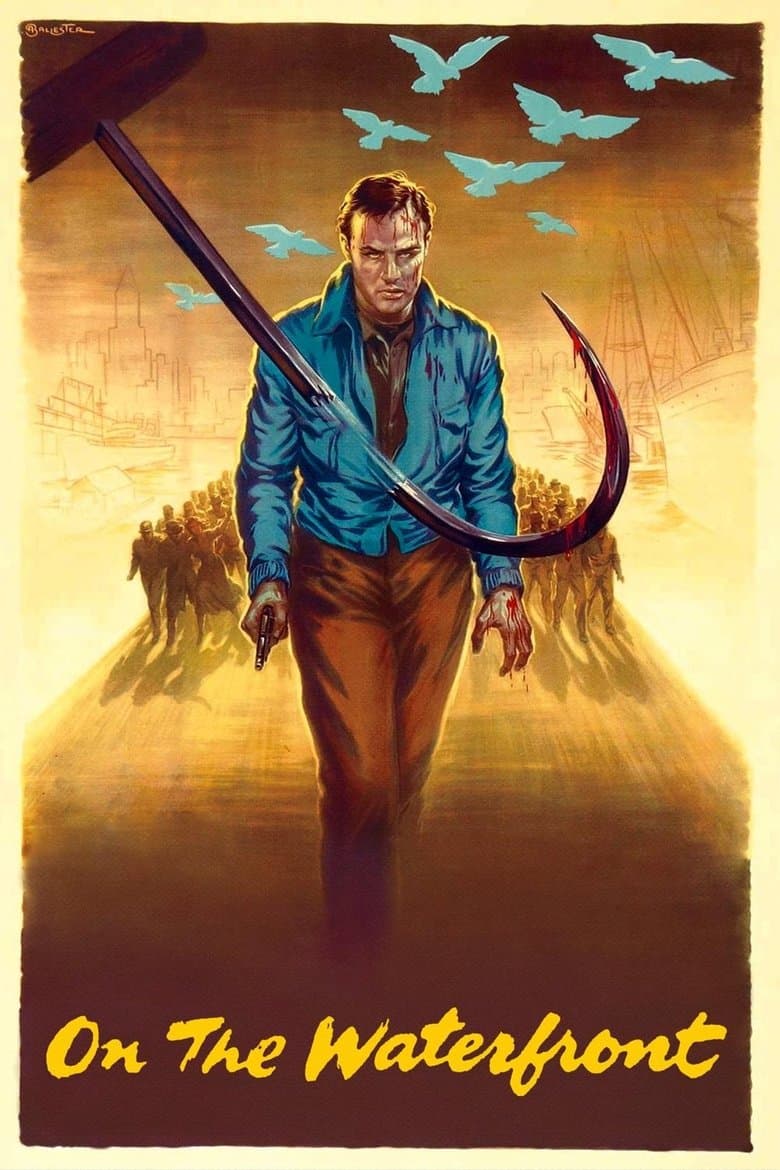
Directed by Elia Kazan, On the Waterfront follows Terry Malloy, a former prizefighter now working as a longshoreman on the docks of Hoboken, New Jersey. Terry becomes entangled in a struggle against the corrupt dockworkers’ union run by ruthless mob figures who control jobs through intimidation and violence. Encouraged by a determined priest and the sister of a murdered dockworker, Terry begins to confront his own conscience and the cost of staying silent. Marlon Brando’s deeply naturalistic performance—including the legendary “I coulda been a contender” scene—helped redefine screen acting for a new generation. Combining gritty realism with powerful moral drama, the film explores themes of courage, redemption, and the price of standing up to injustice.
Watch for
- Marlon Brando’s understated performance style, where small gestures and pauses communicate Terry Malloy’s internal conflict.
- The famous taxi cab scene between Terry and his brother, culminating in the iconic line “I coulda been a contender.”
- The stark black-and-white cinematography that captures the cold, industrial atmosphere of the waterfront docks.
- The film’s powerful final sequence, where Terry’s decision to stand up to corruption becomes both a personal and symbolic act.
Production notes
On the Waterfront was Elia Kazan's adaptation of Budd Schulberg's screenplay (developed from Malcolm Johnson's Pulitzer Prize-winning Sun newspaper series 'Crime on the Waterfront'), produced by Sam Spiegel for Columbia. The film's production was inseparable from Kazan and Schulberg's recent cooperation with the House Un-American Activities Committee, in which both men had named former Communist Party associates; the film's central narrative — about a man's moral obligation to testify against organized crime — was widely interpreted as their attempt to justify those decisions. Marlon Brando played Terry Malloy, with Karl Malden as Father Barry, Lee J. Cobb as Johnny Friendly, Rod Steiger as Charley, and Eva Marie Saint (in her film debut) as Edie Doyle. Boris Kaufman's location cinematography on the actual Hoboken, New Jersey waterfront gave the film an unprecedented documentary-realist quality. Composer Leonard Bernstein wrote his only original feature-film score. Production cost approximately $910,000.
Trivia
- Marlon Brando's famous 'I coulda been a contender' speech, performed in the back of a taxi with Rod Steiger, was largely improvised by both actors; the original script had different dialogue, and the scene became one of the most-quoted single performances in American cinema.
- Director Elia Kazan and screenwriter Budd Schulberg had both cooperated with the House Un-American Activities Committee in 1952, naming former Communist Party associates; the film's narrative — a man morally compelled to testify against organized criminals — was widely interpreted as their public self-justification for those decisions.
- Eva Marie Saint won the Academy Award for Best Supporting Actress in her very first film role — a remarkable debut achievement that has been matched only a handful of times in Oscar history.
- Brando's character Terry Malloy was modeled in part on real Hoboken longshoreman Anthony 'Tony Mike' DeVincenzo, who had testified before the New York State Crime Commission about waterfront racketeering; DeVincenzo later sued the production for using his story without proper credit and won an out-of-court settlement.
- Composer Leonard Bernstein wrote his only original Hollywood feature score for On the Waterfront, having previously composed only the on-stage music for theater productions; he was nominated for the Academy Award for Best Original Score, losing to Dimitri Tiomkin's score for The High and the Mighty.
Legacy
On the Waterfront won eight Academy Awards including Best Picture, Best Director (Kazan), Best Actor (Brando), and Best Supporting Actress (Eva Marie Saint) — one of the most thorough Oscar sweeps in history. It was selected for the National Film Registry in 1989. Brando's 'I coulda been a contender' speech remains one of the most quoted single moments in American cinema, regularly cited in 'greatest scenes' compilations. The film's labor-union and waterfront-corruption setting gave American cinema one of its most enduringly serious treatments of working-class moral life. The film's controversial political subtext — Kazan and Schulberg's HUAC cooperation framed within a pro-testimony allegory — has remained a continuous source of critical engagement; Kazan's 1999 honorary Oscar reignited the debate, with Hollywood splitting publicly between those who applauded and those who refused to do so. Among Kazan's films, On the Waterfront stands as the most thoroughly synthesized achievement of his Method-influenced direction, his collaborative partnerships with serious actors, and his preference for morally serious dramatic subject matter.